
When the Aluminum Heat Exchanger Becomes the
Heater
Gen 2.0 dielectric development at Datec Coating Technologies
Efficient heat transfer matters wherever engineers need controlled heating in limited space, from automotive thermal systems to semiconductor equipment, laboratory instruments and 3D printers. Integrating the heating element into the part that transfers the heat can also simplify the assembly.
What if the heat exchanger itself could become the heater? Datec’s aluminum thick-film platform makes this possible by applying electrically insulating dielectric and resistive heating layers directly onto the exchanger. Our Gen 2.0 dielectric development advances this approach with improved heat transfer in a thinner coating system.
How Direct Printing Changes the Heater Assembly
Conventional stainless steel thick-film heaters commonly use fired dielectric layers to electrically insulate the heating circuit from the metal. In designs that attach a separate heater plate to a heat exchanger, heat must also cross the connection between those components.
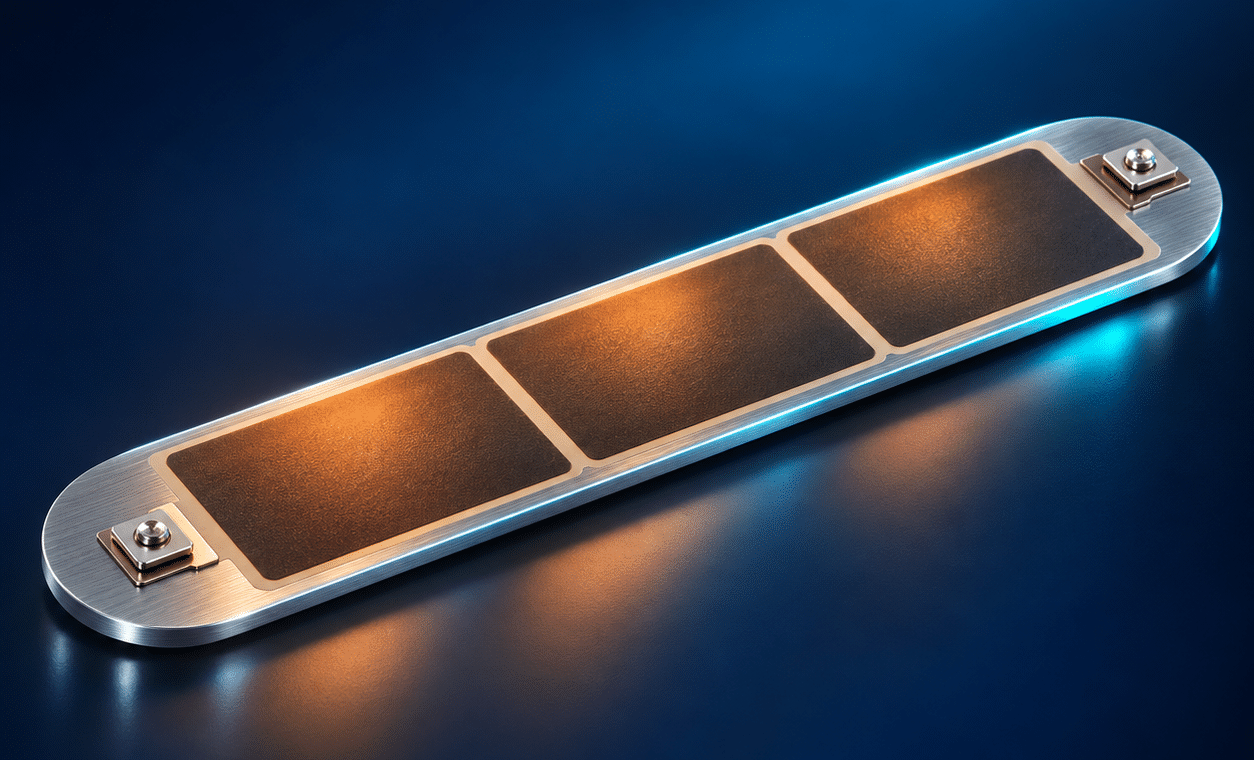
Datec’s technology enables heating elements to be printed directly onto an aluminum heat exchanger, transforming the heat exchanger itself into the active heating component. By integrating the heater and heat exchanger into a single assembly, manufacturers can reduce component count, simplify system design, and eliminate the additional heater plate and its plate-to-exchanger thermal interface. This approach also creates opportunities for more compact, lightweight heating solutions compared to traditional multi-component assemblies.
Why the Dielectric Affects Heat Transfer
The dielectric performs two essential functions: it electrically isolates the heating circuit from the aluminum and allows heat to pass into the exchanger. Higher thermal conductivity and a thinner layer can reduce resistance to that heat flow.
Lower thermal resistance provides benefits beyond reducing heater surface temperature. Improved heat transfer can allow greater compatibility with temperature-sensitive materials and surrounding components while expanding design flexibility. It can also enable higher power densities, support more compact heater designs, and provide additional thermal margin during operation. These advantages help engineers optimize performance without exceeding critical material temperature limits.
Key Results from Datec’s Gen 2.0 Dielectric Testing
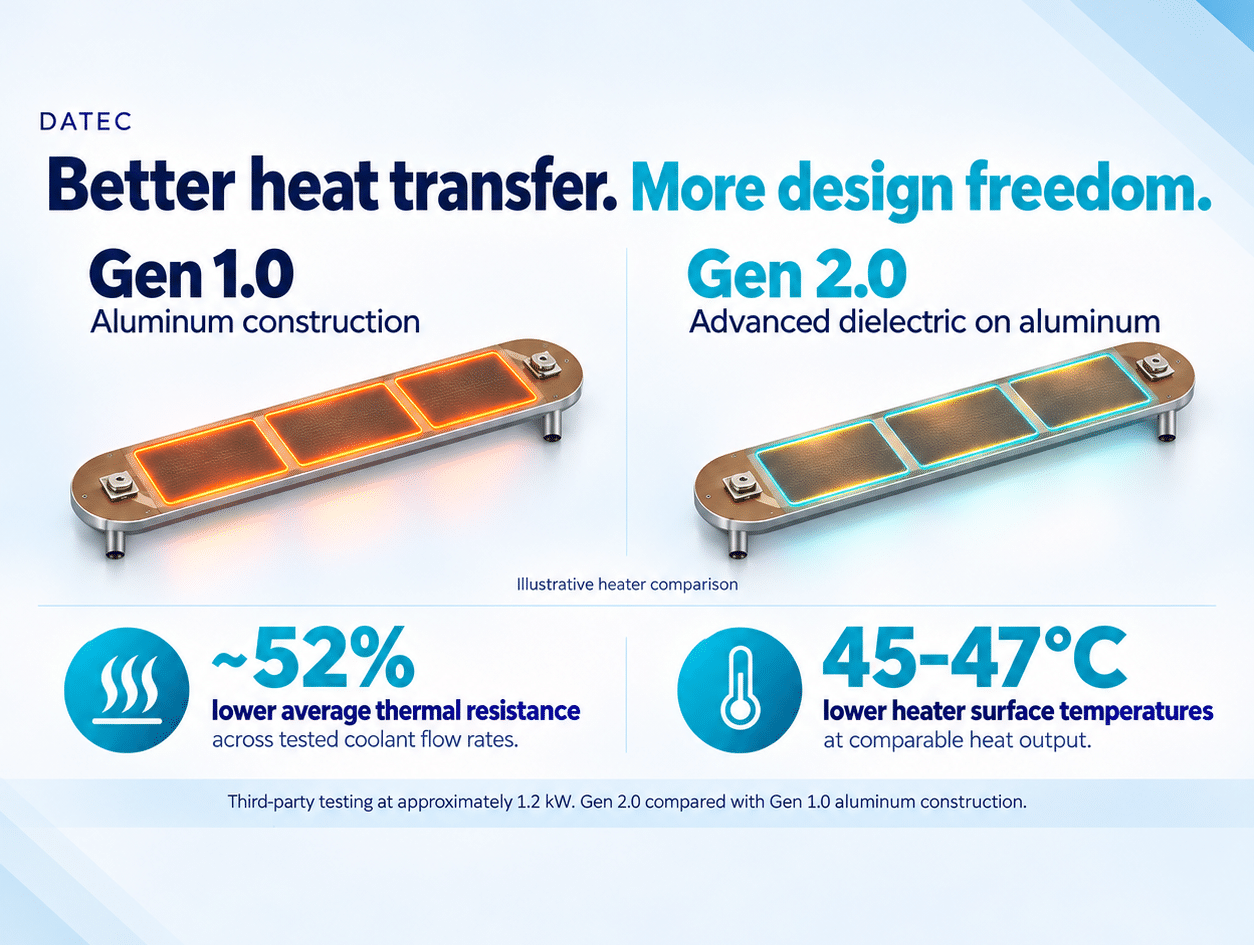
Datec’s latest Gen 2.0 dielectric development delivered significant improvements in heat transfer performance compared to our Gen 1.0 aluminum construction. In third-party testing at approximately 1.2 kW across multiple coolant flow rates, the new system achieved:
- Up to 56% lower thermal resistance.
- Approximately 52% lower average thermal resistance across the tested coolant flow rates.
- Heater surface temperatures up to 47°C lower at comparable power levels.
These improvements indicate more effective heat transfer from the printed heater into the aluminum heat exchanger. For system designers, this means greater thermal efficiency, additional temperature margin, and the potential to support higher power densities while maintaining component reliability.
Key Results from Datec’s Gen 2.0 Dielectric Testing
Datec’s innovation extends beyond dielectric development. Our proprietary resistor technologies are engineered to enhance temperature control, improve thermal uniformity, and optimize overall heating system performance.
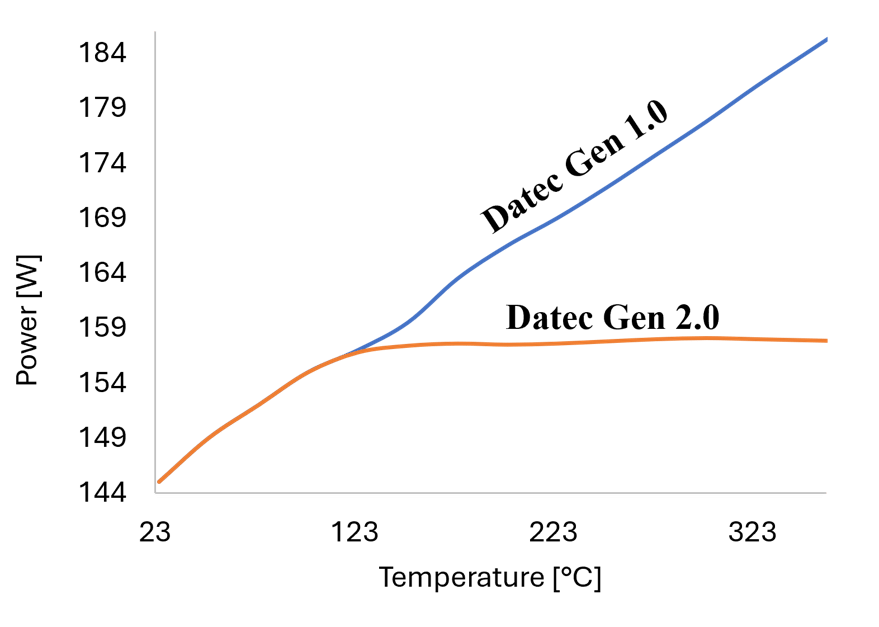
Datec continues developing advanced resistor formulations with tailored temperature-response characteristics, combining Negative Temperature Coefficient (NTC) and Positive Temperature Coefficient (PTC) behavior across specific operating temperature ranges.
The NTC response supports rapid heat-up performance, while our evolving formulations aim to mitigate the inrush current challenges commonly associated with conventional PTC heater systems. At elevated temperatures, the PTC response can help limit power output, introducing an inherent temperature-dependent response that supports more controlled heating.
Compared with Gen 1.0 technology, which relies on an NTC response over the characterized temperature range, this advanced approach offers new opportunities to balance rapid heating, temperature regulation, and power management.
Combined with Datec’s area-based resistor design, these innovations enable more uniform heating by distributing heat generation across the heating surface, supporting improved thermal management and the development of next-generation high-performance heating solutions.
Driving the Future of Electrified Thermal Systems
As electrification continues to expand across industries, efficient thermal management is becoming increasingly important. Datec’s directly printed aluminum heater technology has been developed with high-voltage automotive applications in mind, where performance, efficiency, weight reduction, and packaging constraints are critical.
The same advantages that benefit electric vehicle thermal systems can also create value in a wide range of industrial applications, including:
- Semiconductor equipment, including heated test surfaces and temperature-controlled fixtures.
- Laboratory instruments, including heated blocks and fluid-heating assemblies.
- 3D printing equipment, including heated build surfaces.
By combining efficient heat transfer, electrical insulation, and intelligent resistor technologies into a single integrated solution, Datec is helping shape the next generation of compact, high-performance heating systems.
Discuss your Application with Datec
If heat transfer, electrical insulation and limited space are critical to your design, we would be happy to discuss how directly printed heating could fit. Share your required power, supply voltage, operating temperatures and available heating area to help us assess the next steps.
Contact Datec to discuss your heating application.
FAQ
1. Can heating elements be printed directly onto an aluminum heat exchanger?
Yes. Datec applies a compatible dielectric and thick-film heating circuit directly onto the aluminum exchanger. The exchanger becomes the heater substrate, eliminating the additional plate used in a separate heater assembly.
2. What is the difference from a stainless steel thick-film heater?
A conventional stainless steel heater uses a dielectric and heating circuit on steel. Datec’s approach places the functional layers directly on the aluminum heat exchanger, avoiding the plate-to-exchanger interface in designs that would otherwise attach a separate steel heater.
3. Does a lower heater surface temperature mean less heating output?
No. Datec’s tests demonstrated lower heater surface temperatures at comparable heat output. The result indicates less thermal resistance in the tested construction, creating more temperature margin for the design.
4. Does 52% lower thermal resistance mean 52% lower electricity use?
No. The reported improvement concerns heat transfer and heater temperature. It does not establish a 52% reduction in electricity consumption.
5. Are these advances limited to automotive heaters?
No. Automotive coolant heaters are the current development focus. Semiconductor equipment, laboratory instruments and 3D printing are potential additional applications for this technology.


